Do Protons Have Twice the Mass of Neutrons
Electrons are lighter than neutrons. That is why neutrons spontaneously decay into protons in a very short time period minutes they are heavier contain more energy thus are less stable than protons which have never been observed to decay despite humans best.

It Is Known That Atom Contain Protons Neutrons And Electrons If The Mass Of Neutron Youtube
This problem has been solved.
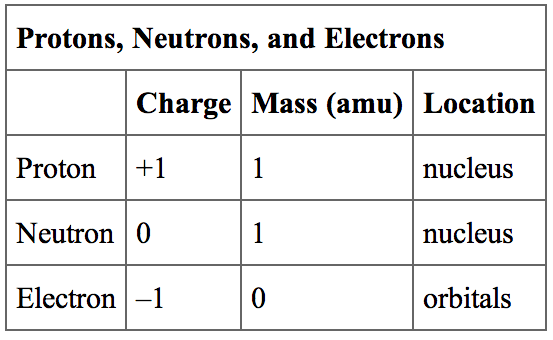
. What mass of electrons is required to neutralize the charge of 10 grams of protons. As I understand the only difference between the two is that a proton consists of two up quarks and a down quark and a neutron consists of two down quarks and an up quark. The only difference is that these particles are 30 heavier than the more common protons and neutrons.
Protons and electrons have charges of opposite signs but the same magnitude. The atomic mass of bromine is 799. See the answer See the answer See the answer done loading.
Protons and electrons have charges of opposite signs but the same magnitude. Which statement about protons is true. Neutrons and protons have mass 1 relative to proton given the value of 1Electrons have mass 11840 relative to proton given the value of 1Protons and neutrons have almost the same mass.
This does not mean however that a proton weighs 00168 u or that the neutron weighs 00195 u for they obviously weigh far more proton 1007277 u. Protons have twice the mass of neutrons. Approximately 18 103.
Protons have twice the mass of neutrons. True or false some electrons have a charge of 1- and some have no charge. Number of Neutrons Mass Number - Number of Protons 1 - 1 0 For zinc the atomic weight is 6539 so the mass number is closest to 65.
Please solve all of them. 3Most atoms have more protons than electrons. So if the number of protons atomic number and neutrons are equal the mass number will be twice the atomic number number of protons for each atom.
Do protons have twice the mass of neutrons. Protons have twice the magnitude of charge as electrons and are the same in sign. This is false because the mass of a proton is essentially the same but just a little bit less than the mass of a neutron.
Which statement about protons is true-Most atoms have more protons than electrons-Protons have a charge of 1-Protons have twice the mass of neutrons-Protons have the same magnitude of charge as electrons but are opposite in sign. I know their masses are almost exactly the same but why arent they EXACTLY exactly the same. The atomic mass is the weighted average of the masses of individual elements weighted by abundance.
Protons have the same magnitude of charge as electrons but opposite in sign. What is happening is that a free neutron has slightly more mass than a free proton. No the mass of 1 proton is almost exactly the same as of 1 neutron.
An atom has 10 neutrons and 10 protons. Protons have twice the mass of neutrons. 4Protons have twice the mass of neutrons.
1Protons have twice the magnitude of charge as 2electrons and are the same in sign. The mass of proton is similar to the mass of neutrons. Protons have twice the mass of neutrons.
The mass number is the the sum of the neutrons and the protons which is 20. Number of Neutrons 65 - 30 35. The proton is made from two up quarks and a down quark while the neutron is made from two down quarks and an up quark.
Please solve these questions as soon as possible. Bromine atoms do not have a number of. An up quark has a mass of 00047 u and a down quark has a mass of 00074 u.
That mass difference is greater than the mass of an electron plus the mass of an anti-neutrino and so the neutron can convert into a proton plus an electron plus an anti-neutrino. Most atoms have more protons than electrons. How many electrons would it take to equal the mass of a proton.
Answer 1 of 8. The mass number is the sum of protons and neutrons. True or false electrons are much lighter than neutrons.
Can protons have twice the mass of neutrons. Electrons are lighter than neutrons. Protons have a charge of 1.
The mass number is the sum of the protons and neutrons in an atom. You can therefore think of the Δ as an excited state of a proton and the Δ 0 as an excited neutron where the increase in energy associated with this excitation ends up increasing the mass of the particle by 30.

Proton Particle In Nucleus With Positive Charge Of 1 And An Atomic Mass Number Of 1 Dalton Neutron No Chemistry Education Proton Neutron Electron Electrons
Atomic Structure Boundless Microbiology
Is An Electron Heavier Or Lighter Than A Neutron Quora


Comments
Post a Comment